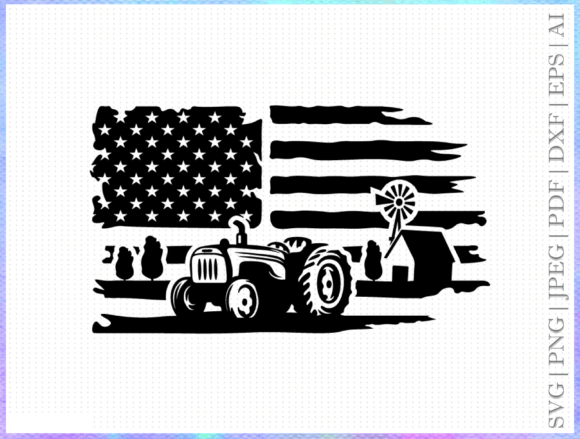
Farm Flag SVG: Graphics for Crafts-Driven Branding
As a brand designer who’s helped over 70 local businesses refine their visual identity—from heirloom jam makers in Vermont to ceramic studios in Austin—I opened Farm Flag SVG expecting rustic charm. What I found was more nuanced: a clean, scalable vector with confident line weight, balanced negative space, and subtle organic texture that reads as warm but not twee. It lands firmly in the “handmade-but-professional” sweet spot—ideal for small business branding where authenticity must coexist with polish.
This graphic design asset evokes grounded optimism: think sun-bleached barn wood, hand-stitched linen, and freshly picked lavender—not cartoonish Americana or overwrought nostalgia. It suggests a brand personality that’s approachable, earth-conscious, and quietly confident. For a local coffee roaster launching seasonal blends, a botanical skincare line sourcing from regional farms, or a children’s clothing boutique using organic cotton, Farm Flag SVG adds narrative depth without shouting. It feels handmade, yes—but also intentional, edited, and commercially viable.
Where Farm Flag SVG Strengthens Real Local Business Presentation
In practice, this SVG shines when integrated into touchpoints customers actually see and hold. For a candle brand based in Asheville, we used Farm Flag SVG as a subtle border on soy wax jar labels—scaled down to 0.25" height—creating instant shelf appeal next to competitors’ flat, text-only packaging. The flag motif reinforced their “mountain-grown, small-batch” story without needing extra copy.
It works powerfully across multiple applications:
- Product labels & hang tags: As a decorative frame or corner accent, it elevates handmade business credibility—especially when paired with serif typography and kraft paper stock.
- Packaging design: On mailer boxes or gift wrap, it serves as a hero graphic at scale—reinforcing brand recognition before the box is even opened.
- Social media graphics: As a watermark or corner motif in Instagram carousels or Reels thumbnails, it builds visual consistency across promotional content.
- Printable design & marketing visuals: We embedded it into a florist’s digital thank-you cards and printable event signage—adding warmth without compromising readability.
- Seasonal campaign visuals: For a Midwest bakery’s fall harvest collection, it anchored banner ads and in-store posters—tying pumpkin bread, apple butter, and cinnamon rolls under one cohesive, non-generic visual theme.
Real Impact on Customer Perception
Small business owners often underestimate how much visual cohesion builds trust. When Farm Flag SVG appears consistently across a soap maker’s product label, website banner, and farmers’ market tent, customers subconsciously register professionalism—even if they can’t articulate why. That consistency strengthens first impression, improves product recognition at crowded craft fairs, and supports clearer visual hierarchy (e.g., letting ingredient lists breathe while the flag adds brand flavor).
For food businesses especially, it softens regulatory-heavy layouts—giving FDA-mandated text room to function while the flag provides emotional resonance. And because it’s an SVG, it scales flawlessly from 3/8" sticker die-cuts to 4' storefront decals—no pixelation, no reworking. That reliability directly translates to more polished marketing visuals and fewer production delays.
Smart Placement: Where It Works Best (and Where to Pause)
Farm Flag SVG excels as a decorative brand element—not a logo replacement. Use it best in these contexts:
- Product mockups (especially for Etsy or Shopify stores)
- Hero graphics on landing pages or email headers
- Accents on thank-you cards, receipt stickers, or packaging tape
- Seasonal packaging—think holiday cookie tins or spring seed packet designs
- Boutique visuals: window clings, shelf talkers, or tote bag prints
- Social media campaign graphics where mood > minimalism
Use carefully—or avoid—in these situations:
- Formal corporate branding (e.g., law firms, financial advisors)
- Very small labels (<0.15") where detail collapses
- Crowded packaging with dense ingredient/legal text
- Luxury minimalist brands relying on whitespace and restraint
- Low-contrast backgrounds (e.g., light gray on white) where edge definition fades
- Any layout where decoration competes with critical information like allergen statements or net weight
Practical Brand Designer Notes Before You Implement
Before locking Farm Flag SVG into your brand identity system, test rigorously:
- Preview it on real packaging mockups—not just screen views—to assess scale, proportion, and contrast against substrate color and texture.
- Check black-and-white output: does the flag retain legibility when printed on uncoated paper or embroidered?
- Test it beside your brand fonts—especially script or handwritten styles—to ensure visual harmony, not competition.
- Verify SVG editability: can you adjust stroke weight or isolate elements for color customization? Not all “SVG” files are truly vector-editable.
- Confirm commercial license coverage—especially if applying it to physical products for resale (e.g., mugs, apparel, stickers). This isn’t clipart for personal use; it’s a commercial design asset.
- Compare it against competitor packaging: does it differentiate—or accidentally echo another local brand’s motif?
- Review PNG transparency: if using raster versions, ensure clean edges and alpha-channel integrity for overlay work in Canva or Adobe Express.
Remember: Farm Flag SVG isn’t a shortcut—it’s a strategic tool. When thoughtfully placed within a cohesive brand identity, it deepens storytelling, reinforces local roots, and elevates handmade business credibility. Used without intention, it’s just decoration. Used with purpose—as part of your broader packaging design, social media graphics, and small business branding strategy—it becomes quiet authority on the shelf, screen, and sidewalk.